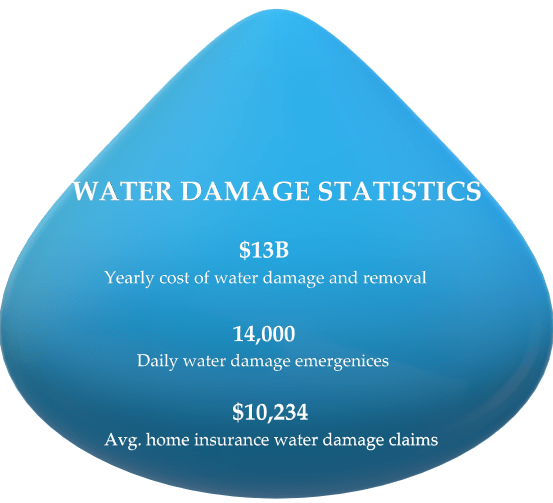
Water damage claims costing over $500,000 have doubled since 2015. Non-weather water damage claims are the second most common type of homeowner insurance claim, behind wind damage.
Water from flood damage can affect any property, regardless of age. New homes are just as likely to experience water damage issues as older homes. They are built with lower quality materials and quite often have poor quality workmanship in plumbing. Older homes tend to cost less to repair, as well.
The top causes of water damage in the home:
- Appliance leaks or failure
- Sewer backup or clog
- Water overflow & buildup
- Plumbing, leaking or burst pipes
There are three categories of water damage, the first two being the most common.
- Category 1, aka white water, is from a hygenic source, like a water supply line, rain or melted snow.
- Category 2, aka grey water, has been exposed to contaminants, like bath/shower water or appliance discharge.
- Category 3, aka black water, is contaminated and may come from contaminated sources like toilets, sewers or natural body of water overflows.
Within 48 hours or less, clean or grey water can deteriorate to black water, and areas that experience clean water intrusion can quickly become toxic. Black water and contaminated materials have to be removed, or the result can be airborne contamination even after being dried. Most porous and absorbent materials contaminated by black water are unsalvageable. There are many safety considerations to drying a house that has had a black water flooding event, and a certified professional company should always be called to handle those jobs.
The level of water intrusion in a water damage event is measured by the amount of water, materials affected and level of absorption. There are four classes with Class 1 being the least dangerous and Class 4 the worst.
- Class 1 – Small water flow to area and materials are low porosity (i.e., tile floor). Once bulk of water has been removed, very little moisture remains, and minimal drying is needed. Can deteriorate to Class 2 or 3.
- Class 2 – Significant amount of water that has soaked into carpet, drywall or other porous materials. Can deteriorate to Class 3.
- Class 3 – Highest amount of water and absorption by surrounding porous materials. Greatest level of removal and drying involved with the wet area and structural surfaces.
- Class 4 – Most of the moisture is trapped within the building materials with extremely low chance of evaporation after bulk water removal. May require special drying methods, longer drying time and/or structural disassembly.
Water moves quickly and has potential to cause major damage. So, it’s important to move quickly to stop the water flow at its source and begin removing sitting water. The longer water sits after a flood or water damage, the more damage it will cause and more likely become contaminated.
Minutes: Water will move along path of least resistance and be absorbed by anything in its way and begin to cause stains.
Hours: Furniture in contact with water will swell, distort and weaken. Non-colorfast dyes in fabrics that have been soaked will begin to bleed and damage whatever is in contact.
24 Hours: Condition of furniture, building materials and cabinetry will continue to deteriorate. Humidity will begin to cause strong odors.
Days: Building materials (i.e., wooden floors, drywall, framing) will be warped and unsalvageable and paint/wallpaper will blister and peel. Fungi and mold will be visible and musty odors present.
Weeks: Organic materials will be infested with mold and the building may have to be taken down to the studs. Home may be hazardous to health due to microbial growth.
Months: Home may become total loss, due to cost of repairs being too high, insurance denies claims due to neglect or homeowner may be dropped from their policy.
It can take up to 18-24 months for the intire water damage claim process – insurance claims and repairs to be completed. It can be frustrating and time consuming, so understanding your homeowner’s policy in advance, in relation to water events, can help smooth the process.
To read the original article click here.

